Showing posts with label sport. Show all posts

Sunday, October 30, 2011

With a final round of 4-under 68, Ken Duke won the Nationwide Tour Championship at Daniel Island and punched his ticket back to the PGA Tour for 2012. Duke won the season finale by two shots over 54-hole leader Scott Brown. Duke went from 36th to seventh on the money list with the win. The top 25 players on the money table earn PGA Tour status for next season. The 42-year-old said his hard work brought him back to the big tour. “I’m older now, but I’ve hired a trainer and have worked very hard to keep up,” said Duke. “I’ve lost a lot of weight and gained a lot of strength in my core. I have a lot more flexibility and hopefully I can keep right on going.” Duke returns to the PGA Tour after playing in 2004 and from ’07-’09, earning three runner-up finishes. Brown finished eighth on the money list, one behind Duke, and earned a tour card as an outstanding consolation prize. “This is an absolute dream come true,” said Brown. “I’m still numb. I’m sure it will come to me later on tonight. The year has been kind of like a rollercoaster….up and down, but the finishes have been up there. I can’t wait to get to that next level and see how I measure up.” J.J. Killeen, twice a winner this season, topped the money list with $414,273 in earnings.


With a final round of 4-under 68, Ken Duke won the Nationwide Tour Championship at Daniel Island and punched his ticket back to the PGA Tour for 2012.
Duke won the season finale by two shots over 54-hole leader Scott Brown. Duke went from 36th to seventh on the money list with the win. The top 25 players on the money table earn PGA Tour status for next season.
The 42-year-old said his hard work brought him back to the big tour.
“I’m older now, but I’ve hired a trainer and have worked very hard to keep up,” said Duke. “I’ve lost a lot of weight and gained a lot of strength in my core. wholesale jerseys I have a lot more flexibility and hopefully I can keep right on going.”
Duke returns to the PGA Tour after playing in 2004 and from ’07-’09, earning three runner-up finishes.
Brown finished eighth on the money list, one behind Duke, and earned a tour card as an outstanding consolation prize.
“This is an absolute dream come true,” said Brown. “I’m still numb. I’m sure it will come to me later on tonight. The year has been kind of like a rollercoaster….up and down, but the finishes have been up there. I can’t wait to get to that next level and see how I measure up.”
J.J. Killeen, twice a winner this season, topped the money list with $414,273 in earnings.

Wednesday, September 21, 2011

The New York Yankees can clinch their 16th playoff berth in the last 17 years by winning once in their day-night doubleheader Wednesday vs. the Tampa Bay Rays.
The Yankees reduced their magic number for a postseason berth to 2 with Tuesday's 5-0 win over the Rays. Any combination of Yankees wins and Rays losses totaling two vaults New York into its customary place in the playoffs.
The Yankees (93-60) also have a magic number of 3 for clinching the American League East Division. If they sweep the doubleheader and Boston mlb jerseys cheap (88-67) loses to Baltimore, they clinch the division.
The Red Sox are two games ahead of the Rays (85-68) in the race for the AL wild card but just one game in the loss column.
On the fringe of the wild card race are the Los Angeles Angels (84-70), who are 3 1/2 games behind the Red Sox and five games behind the first-place Texas Rangers (89-65) in the AL West. The Rangers have a magic number of 4.
In the National League wild card race, the Atlanta Braves (88-67) maintained a 2 1/2-game lead over the St. Louis Cardinals (85-69) as both teams won Tuesday. The defending World Series champion San Francisco Giants (83-71) lost Tuesday and are 4 1/2 games behind the Braves.
The Milwaukee Brewers (91-64) have a magic number of 3 to clinch the NL Central, as do the Arizona Diamondbacks (89-66) to wrap up the NL West.

Tuesday, September 6, 2011

Ruthless Federer races to Monaco victory

Roger Federer was left waiting until almost midnight to start his US Open fourth round match on Monday, but made up for the delay with a brutal 6-1 6-2 6-0 win over Argentine Juan Monaco to reach the quarter-finals.
The five-time champion took the first set in 18 minutes and barely slowed down after that as the third-seeded Swiss eliminated his unseeded opponent in just 82 minutes under the Arthur Ashe Stadium court floodlights.
The lightning-quick win, which came as rain clouds gathered and mist filled the air at the National Tennis Center, marked the Swiss master's 30th successive trip to the quarter-finals of a grand slam event, dating back to the 2004 French Open.
The 16-time major champion advanced to a mouth-watering clash against 11th seeded Frenchman Jo-Wilfried Tsonga, who rallied to overcome eight-seeded American Mardy Fish in five sets earlier in the day.

Saturday, August 13, 2011

Rodman always on the rebound


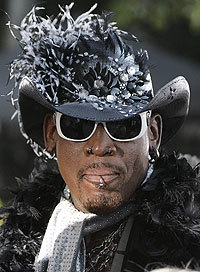
The numerous tattoos, piercings and entourage were expected. What else to expect from Dennis Rodman’s trip to the Naismith Hall of Fame? Flamboyance is normal for Rodman.

Perhaps his goal was to overshadow his career accomplishments, or obscure the insecurities of the poor kid from Dallas who turned himself into one of sports biggest personalities, setting a trail for professional athletes who determine their own brand.

Last night, donning a black-glittered sweatsuit with Pistons and Bulls spelled on the back, Rodman held back tears during his 11-minute acceptance speech, finally attempting to make amends with his estranged mother, Shirley, who was in the audience.

It was a brilliant admission by someone who became a trailblazer in determining his fate, however adversely it affected his career. Although his appearance, off-the-court antics, and bizarre on-court behavior often blurred his impact as a remarkable rebounder and team player, Rodman did not apologize for his actions until last night.

What he proved during his 14-year NBA career with the Pistons, Spurs, Bulls, Lakers, and Mavericks was that an athlete could seize control of his image. While Michael Jordan cherished and protected his image almost obsessively, Rodman was a champion for self-expression, regardless of how it tarnished his public persona.

So why should he care now? Because deliberation and contemplation are the themes for every Hall of Famer this weekend in Springfield. The great ones consider what they could have done better, and Rodman is a great one. He outworked his opponents on the boards, leading the league in rebounding a whopping seven times, including three seasons of averaging 17 or more.

Rodman averaged in double figures in scoring just once in his career - his second season with Detroit - but he’s in Springfield because of hustle and sacrifice.

At 50, Rodman realizes his impact on the game, but he also understands how his selfishness and self-indulgence affected his family. The exhibitionism came at a cost. The expression was painful and has lasted into life after basketball, where he has endured troubles and demons.

But he seems willing to accept his detractors, because basketball, in the end, was his focus.

“I never imagined to be here,’’ Rodman said. “If you would have told me this 15 years ago, I would have told you I never knew what this was. It’s hard to be an entertainer and athlete and be a smart basketball player at the same time. As you can see, some guys try to do it but they don’t know how to put the game of basketball first. That’s one thing I did. Entertainment could come at any time of the ballgame.

“Thankful for me I went to Chicago, and they let me be the person I wanted to be. Everywhere I go around the world, you catch 8-, 9-year-old kids saying ‘Oh my God, I love you, I love you’ and [they’ve] never seen me play. You don’t know who I am. I haven’t had a job in 15 years, but I am relevant around the world. And I’m still being an integral part of people’s lives. I respected the game of basketball and that’s why I think I am here.’’

And NBA observers who judged Rodman’s every drop of dye, every ink of tattoo, and every marriage ceremony, acknowledged his greatness in spite of his strangeness. So that’s why he is here. He has spent the weekend respecting the Hall, mostly avoiding his brutal and sometimes painful honesty.

“I have one regret about playing basketball and being an athlete,’’ said Rodman, who has three children. “Being a father, a regret. That’s about it. Basketball, I would never change anything but off the court, it’s a whole different ballgame, bro. I would be there [with my kids] instead of being selfish. Instead of being the clown, the jester, the look-at-me-now type of person. If I would have took a few more days to understand what it was like to be a well-grounded and great human being instead of a great athlete, I think I would probably be a better person.’’

Rodman said he wanted his 10-year-old son D.J. to present him last night, and his second choice was Pearl Jam lead singer Eddie Vedder, but he accepted Phil Jackson after the Hall of Fame committee made the decision. D.J. and Rodman’s daughter Trinity walked with their father down the aisle as he was introduced, and D.J. sported dad’s cowboy hat.

“I’m not going to live forever, I need to decide if I need to balance my life out with the party life or the scene or the other stuff in my life, or live my life and try to keep my family together and look at my kids be happy and grow up,’’ Rodman said.

“I don’t need the Hall of Fame to hold a major press conference to tell people how [bad off] I was. I don’t need this. This is to let people know I’m not just an entertainer. But to let people know I do have a family. I do have some cool kids. I do have a wife that’s living. I do have a mother that’s living. I have good, caring people that’s been through thick and thin with me and had my back.’’

Rodman seemingly had gotten so much out of this trip to Springfield.

Monday, July 18, 2011

Open champion Darren Clarke reveals he almost quit in April


Darren Clarke thought about giving up professional golf in April after a round of 81 in Morocco but was persuaded, against his instincts, to go on holiday, regroup and come back refreshed. On balance, the new Open champion probably made the right decision.
For one thing, he is now considerably richer. Along with the £900,000 winner's cheque, he will receive a £2m bonus from one of his sponsors on Wednesday, as well as countless other benefits – appearance fees and such like – that come the way of major champions.
More importantly, by sticking with the game the Northern Irishman was sticking with the very fibre of his being. He is – as he confirmed during the course of a hungover post-victory press conference at Royal St George's – a golfer to the core. The son of a greenskeeper picked up the game as an 11-year-old, discovered an aptitude and developed a love. He turned professional in 1990, won his first European Tour event three years later and over the next 20 years fashioned a career that could be a judged a solid B+. But now this: the Champion Golfer of the Year, as the R&A designates the winner of its annual shindig.

When the prize-giving was over and the hordes had departed Royal St George's, Clarke returned to a rented house for the party of all parties.
The Claret Jug was passed around and admired as the champion mingled with family and guests and posed for photographs. Clarke's ubiquitous agent and long-time friend, Andrew Chandler, spoke of the frustrations that drove his man to the brink this year. "He was so low he thought about giving it up," he said. "It was the lowest I have ever seen him. He wasn't hitting the ball like he used to in Morocco, so I told him to take extra holiday. He went away for three weeks and came back refreshed." Two weeks after his return Clarke won a European Tour event in Mallorca.
No offence to the Iberdrola Open and those who played in it, but in the grander scheme of things Clarke's victory that week did not set the world alight. And it certainly did not portend the events at Sandwich over the weekend.
Yet it takes talent to win a golf tournament and that victory, his first in three years, suggested Clarke was not ready to go quietly into the golfing night just yet. "It happens about once every three years that I get in the right mood and play the kind of golf I am capable of playing," he explained between glasses of champagne.
This time the gap between victories was three months – a dramatic shortening of the cycle for which he gave credit to his fiancee, Alison Campbell, and to a reunion with the sports psychologist Bob Rotella, with whom he has worked sporadically over the course of his career. The pair had not met face to face for a year until the start of last week. They were inseparable for the duration.
"No, I won't," Clarke said when asked to explain what he and Rotella had spoken about. Fortunately, the psychologist was not so shy. "Darren had been getting more and more frustrated with his putting and that was affecting his whole game," Rotella said. "I told him, 'You are going to have to go unconscious'. I told him I didn't want him to think about technique. I just wanted him to look where he wanted the ball to go and hit it – like he did when he was 12 years old.
"I used to work with stammerers: 98% of them could talk when they were in their bathroom; it was just that little doubt in public which tied them up. He had the skills – he's a talented athlete; it was a question of freeing them up."
Easier said than done, of course, especially in the madness of an Open Championship setting. Luckily for Clarke, who practises regularly in bad weather at Royal Portrush, his home club, the conditions at Sandwich were appalling. This meant two-thirds of the field, those who had neither the tools nor the inclination to persevere in the squalls, could immediately be dismissed. As for the other third, including players such as Phil Mickelson and Dustin Johnson, they did not have the tools to match a man enjoying the golfing week of his life.
"I play my best when I'm fat," Clarke said a couple of times during the week, and on widescreen television screens up and down the land he cuts a less than athletic figure. But standing next to him at his celebration party he did not look fat at all. He looked solid, athletic even, with huge hands and arms that look capable of bending raw steel.
More than anything he looked fulfilled – a changed man, as he conceded. "I used to give myself airs and graces when I was younger," he said in the glow of victory. "I have to admit I was a prat. I was rude to people if I'd had a bad round, and it wasn't right. But I like to think I have learned from my mistakes."

Open champion Darren Clarke reveals he almost quit in April


Darren Clarke thought about giving up professional golf in April after a round of 81 in Morocco but was persuaded, against his instincts, to go on holiday, regroup and come back refreshed. On balance, the new Open champion probably made the right decision.
For one thing, he is now considerably richer. Along with the £900,000 winner's cheque, he will receive a £2m bonus from one of his sponsors on Wednesday, as well as countless other benefits – appearance fees and such like – that come the way of major champions.
More importantly, by sticking with the game the Northern Irishman was sticking with the very fibre of his being. He is – as he confirmed during the course of a hungover post-victory press conference at Royal St George's – a golfer to the core. The son of a greenskeeper picked up the game as an 11-year-old, discovered an aptitude and developed a love. He turned professional in 1990, won his first European Tour event three years later and over the next 20 years fashioned a career that could be a judged a solid B+. But now this: the Champion Golfer of the Year, as the R&A designates the winner of its annual shindig.

When the prize-giving was over and the hordes had departed Royal St George's, Clarke returned to a rented house for the party of all parties.
The Claret Jug was passed around and admired as the champion mingled with family and guests and posed for photographs. Clarke's ubiquitous agent and long-time friend, Andrew Chandler, spoke of the frustrations that drove his man to the brink this year. "He was so low he thought about giving it up," he said. "It was the lowest I have ever seen him. He wasn't hitting the ball like he used to in Morocco, so I told him to take extra holiday. He went away for three weeks and came back refreshed." Two weeks after his return Clarke won a European Tour event in Mallorca.
No offence to the Iberdrola Open and those who played in it, but in the grander scheme of things Clarke's victory that week did not set the world alight. And it certainly did not portend the events at Sandwich over the weekend.
Yet it takes talent to win a golf tournament and that victory, his first in three years, suggested Clarke was not ready to go quietly into the golfing night just yet. "It happens about once every three years that I get in the right mood and play the kind of golf I am capable of playing," he explained between glasses of champagne.
This time the gap between victories was three months – a dramatic shortening of the cycle for which he gave credit to his fiancee, Alison Campbell, and to a reunion with the sports psychologist Bob Rotella, with whom he has worked sporadically over the course of his career. The pair had not met face to face for a year until the start of last week. They were inseparable for the duration.
"No, I won't," Clarke said when asked to explain what he and Rotella had spoken about. Fortunately, the psychologist was not so shy. "Darren had been getting more and more frustrated with his putting and that was affecting his whole game," Rotella said. "I told him, 'You are going to have to go unconscious'. I told him I didn't want him to think about technique. I just wanted him to look where he wanted the ball to go and hit it – like he did when he was 12 years old.
"I used to work with stammerers: 98% of them could talk when they were in their bathroom; it was just that little doubt in public which tied them up. He had the skills – he's a talented athlete; it was a question of freeing them up."
Easier said than done, of course, especially in the madness of an Open Championship setting. Luckily for Clarke, who practises regularly in bad weather at Royal Portrush, his home club, the conditions at Sandwich were appalling. This meant two-thirds of the field, those who had neither the tools nor the inclination to persevere in the squalls, could immediately be dismissed. As for the other third, including players such as Phil Mickelson and Dustin Johnson, they did not have the tools to match a man enjoying the golfing week of his life.
"I play my best when I'm fat," Clarke said a couple of times during the week, and on widescreen television screens up and down the land he cuts a less than athletic figure. But standing next to him at his celebration party he did not look fat at all. He looked solid, athletic even, with huge hands and arms that look capable of bending raw steel.
More than anything he looked fulfilled – a changed man, as he conceded. "I used to give myself airs and graces when I was younger," he said in the glow of victory. "I have to admit I was a prat. I was rude to people if I'd had a bad round, and it wasn't right. But I like to think I have learned from my mistakes."

Saturday, July 16, 2011

Players' secret lockout insurance could have sparked talks

From the moment he was elected executive director of the NFL Players Association in March 2009, DeMaurice Smith always took the long view when it came to negotiations with the owners on a new collective bargaining agreement. Hope for the best, plan for the worst.
It's one of the reasons that slightly more than a year ago he received approval from the executive committee to secure insurance that would pay each player roughly $200,000 if there were no football in 2011.
Smith disclosed the fund to only a handful of people outside of the executive committee. However with negotiations seemingly at a standstill late Wednesday night, the decision was made to play one of their aces in the hole. So in the relative quiet of the sides' New York City bargaining room the next morning, Baltimore Ravens cornerback Domonique Foxworth informed the owners of the previously secret lockout fund.
Was that the shove in the back that moved the sides closer to a potential agreement? Only the owners know for sure, but a source close to one of them said the disclosure definitely got that side's attention. Perhaps for good reason.

The common perception has been that the players' solidarity would crumble once they started missing paychecks. However the foundation beneath that line of thinking would be as solid as Jell-O if the players could couple the insurance with a large financial award from U.S. District Judge David Doty, who previously ruled the owners had illegally created a $4.3 billion lockout fund for themselves by renegotiating their TV deals at the expense of the players.
"Players Association leadership looked into this as a last possible resort to keep players together in case games would be missed," one players-side source said of the insurance war chest. "It was never intended to be used as a bargaining chip or negotiating point until things became critical."
Thursday was a critical point. If the sides could not advance negotiations then the possibility of hundreds of millions of dollars being lost to canceled preseason games was real. And if the owners allowed the impasse to get that far, what was to stop them from testing the players' pain threshold by extending the lockout into the regular season?
The Players Association began informing its membership about the insurance fund over the past week and brought it up in the negotiating room for the first time Thursday. There's no way to know at this time whether it was the final oomph that pushed negotiations onto positive ground, but it's hard to believe it didn't have some impact considering the talks were "not in a good place" the previous night when the sides broke for the day.

Thursday, July 7, 2011

Football Hall of Famer John Mackey Dies at 69

John Mackey, the rugged Hall of Fame tight end and union president who later fought for stronger health benefits of retired players and struggled with dementia, has died. He was 69.
Mackey's wife notified the team about her husband's death, Baltimore Ravens spokesman Chad Steele said Thursday. No official cause was given.
Mackey played for the Baltimore Colts from 1963-71, and helped the team beat the Dallas Cowboys in the 1971 Super Bowl by catching a pass from Johnny Unitas after it deflected off two other players for a 75-yard touchdown.

He also played for the San Diego Chargers in 1972, and finished his 10-year career with 331 catches for 5,236 yards and 38 touchdowns.
Mackey's efforts after his playing days were just as important as his performance on the field. An NFL labor agreement ratified in 2006 includes the "88 Plan," named for Mackey's number, 88. It provides up to $88,000 a year for nursing care or day care for ex-players with dementia or Alzheimer's disease, or $50,000 for home care.

"John Mackey is still our leader. As the president of the NFLPA, he led the fight for fairness with a brilliance and with ferocious drive," union executive director DeMaurice Smith said. "His passion continues to define our organization and inspire our players. His unwavering loyalty to our mission and his exemplary courage will never be forgotten."
The health care of former players has become a prominent issue in the negotiations for a new collective bargaining agreement. An NFL lockout has been going on since March.
"John Mackey was one of the great leaders in NFL history, on and off the field," Commissioner Roger Goodell said. "He was a Hall of Fame player who redefined the tight end position. He was a courageous advocate for his fellow NFL players as head of the NFL Players Association. He worked closely with our office on many issues through the years, including serving as the first president of the NFL Youth Football Fund. He never stopped fighting the good fight."
Mackey was drafted in 1963 out of Syracuse -- by the NFL's Baltimore Colts in the second round, and the AFL's New York Jets in the fifth round.
He wound up playing for the Colts just as the passing game was taking on a major role in pro football. His size, speed and ability to catch the ball while also blocking in the running game made him the prototype for future generations of tight ends.
"John revolutionized the tight end position during his Hall of Fame career, and he laid the foundation on and off the field for modern NFL players," Ravens general manager and fellow Hall of Fame tight end Ozzie Newsome said.
He caught 35 passes for 726 yards as a rookie in 1963, when he was selected to the first of five Pro Bowls. He also was voted first-team All-Pro by The Associated Press in 1966, '67 and '68.
Mackey helped the Colts beat the Dallas Cowboys in the '71 Super Bowl. His touchdown on a 75-yard pass play helped set the stage for a 16-13 win on Jim O'Brien's 32-yard field goal in the closing seconds.
After he retired, Mackey joined Mike Ditka as the first tight ends selected to the Pro Football Hall of Fame. The John Mackey Award was established to honor the nation's top college football tight end, and Syracuse retired his number in 2007.
"John was the perfect role model for Syracuse football student-athletes," Syracuse coach and former NFL player Doug Marrone said. "He was a larger-than-life man and he influenced so many people. Many consider him the greatest tight end in NFL history and he was a pioneer in the development in the NFL Players Association."
Mackey has become closely associated with the plight of many former players who helped build the NFL in the era before million-dollar contracts, safer equipment and better health care.
He suffered from frontotemporal dementia in later years that is believed to have been caused by the contact associated with playing football. Four years ago, the dementia forced Mackey into living in an assisted-living facility.
The costs associated with his care, which far outpaced Mackey's pension, led to the "88 Plan" for retired players. Now, former players are pushing for better pension plans and health benefits from the league.
"John Mackey has inspired me and will continue to inspire our players," Smith posted on Twitter. "He will be missed but never forgotten."

UPDATE 1-Olympics-S.Korea expects huge economic boost from Winter Games

Shares in South Korean casino and resort operators and construction firms spiked on Thursday, buoyed by expectations that Pyeongchang's hosting of the 2018 Winter Olympics could pump tens of billions of dollars into the economy.
At an International Olympic Committee meeting, South Korea won the right to host the contest at the third attempt, capping a decade-long campaign to bring winter sports to this rustic town, and sparking all-night celebrations.
A study by the Hyundai Research Institute has said hosting the 2018 Games will inject 65 trillion won ($61 billion) into Asia's fourth largesteconomy through investment, spending, and spin-off consumption.
On the Seoul stock exchange, Seunghwa Premium Construction Co surged to its daily limit of 15 percent on expectations the builder might be involving in the construction of a highway to Pyeongchang.
Hyundai Cement , which owns a resort in Gangwon Province, home to Pyeongchang, also surged 15 percent, while shares in casino operator Kangwon Land jumped as much as 9.5 percent.
The winning bid was a coup for Korea Inc. as major conglomerates threw their support behind the bid, which was headed by Cho Yang-ho, chairman of flag carrier Korean Air Lines 003490.Ks. Samsung chairman Lee Kun-hee is the country's sole IOC member.
Japan is the only Asian country to host a Winter Olympics -- in Sapporo in 1972 and Nagano in 1998.
Pyeongchang ran under the slogan "New Horizons", arguing Asia's stellar economic growth in recent decades and the continent's massive population offered an untapped market for winter sports.
South Korea also hopes the event will serve as a catalyst for improved ties for rival Koreas, which stand at war technically under a truce that ended their 1950-53 conflict and have engaged in confrontations that have made tension on the peninsula a constant backdrop to economic development.
"This is a day for both South and North Korea," Unification Minister Hyun In-taek said at a former military training ground in Hwacheon, about 30 minutes drive from the North Korean border at a groundbreaking ceremony for a new centre for defectors, whose numbers have swelled in the South.
For many local residents, the Games come as a chance to breathe life into their sleepy town and help portraying a better image for their country as a place of skilled bureaucracy and business opportunities.
"I think this will help Korea's brand name," said Kim Young-soo, 39, who runs a lubricants shop in the nearby town of Chuncheon. "Korea has been seen as a more difficult place to do business than other developed countries."
Kim was among the nearly 1,000 local residents and visitors who gathered around the Alpensia resort, one of the planned venues for the 2018 Games, dancing to a K-pop boy band and enjoying Korean folk dance and songs before the decision.
Robed monks and hundreds of soldiers in fatigue were among the throng of patriotic supporters waving the flag and "clapper" balloons popular at South Korean sports events, emblazoned with the bid's logo "New Horizons."
South Korea hosted the Summer Games in 1988 and the World Cup soccer finals together with Japan in 2002.

Friday, April 29, 2011

Panthers take Cam Newton first

Cam Newton's selection as the No. 1 pick was perhaps the only predictable element of this most unusual NFL draft.

While the league's labour dispute played out in the courts, and the commissioner struggled to speak over a howling crowd chanting “We want football,” the draft got under way Thursday night with a few surprises.

Newton was not one of them.

The Auburn quarterback and Heisman Trophy winner went to the Carolina Panthers —the worst team in the league — and vowed to immediately fix that. Newton led Auburn to an undefeated season and its first national championship since 1957.

“I'm ready to change this whole organization around, to go from worst to first,” he said. “Just being a Panther is the most special part about this.”

Not so special but certainly unusual was Commissioner Roger Goodell getting booed as he prepared to conduct a moment of silence for victims of the devastating storms that ripped through the South. He responded to their chants for football by saying, “I hear you. So do I.”

Then he was bear-hugged by a player who is suing the league.

With the second pick, Denver took Texas A&M linebacker Von Miller, a plaintiff in the antitrust lawsuit players filed to block the lockout. He strode across the stage with tears in his eyes and embraced Goodell.

“I've never had anything against Roger Goodell,” Miller said. “I just want to make sure football continues to get played. When I walked across the stage, I was meeting the commissioner. That was it.”

Later, offensive lineman Danny Watkins of Kelowna, B.C., was selected 23rd overall by the Philadelphia Eagles. Watkins is the fourth Canadian to be picked in the first round of the NFL draft.

The guard from Baylor apologized to Giants fans in the audience who booed him for going to the rival Eagles. Watkins was told to get used to such treatment in New York.

The 26-year-old Watkins is a former firefighter who took an unconventional route to the NFL. He has more experience as a firefighter (five years) than a football player (four) and played hockey and rugby in high school. Several Kelowna firefighters were in attendance in New York, and hockey personality Don Cherry announced his pick on CBC during the second intermission of the NHL playoff game between the Vancouver Canucks and the Nashville Predators.

Watkins, listed at six-foot-four and 312 pounds, played left tackle in college, but projects as a guard in the pros. He could help an offensive line that allowed 49 sacks last season, despite the presence of Michael Vick.

It was a strange opening for what normally is a festive occasion. In this off-season of labour strife, the league's first work stoppage since 1987 temporarily ends Friday. The 32 teams will resume business in compliance with U.S. District Judge Susan Richard Nelson's order to lift the lockout.

Then again, the lockout could be back in place if the NFL wins an appeal. If that happens, Newton, Miller and all the players chosen Thursday night would be thrown back into a labour limbo.

For now, they will be allowed to report to their teams, meet coaches and get playbooks. Contract negotiations are uncertain until the league announces its rules for the 2011 season — rules that might be in force for only a short time if an appeal is granted.

The draft was never in danger of being held because it was protected under the old collective bargaining agreement that expired in March.

Moments before the annual spring ritual got under way, Goodell requested a moment of silence for victims of Wednesday's storms, which left at least 280 people dead in six states and hundreds more injured. On stage, he was surrounded by the Auburn and Alabama stars and their coaches.

Of those stars, none shined brighter than Newton, who has shown he can handle the heat of a spotlight. He turned in a sensational 2010 season while the NCAA investigated his recruitment. Newton's father, Cecil, has admitted soliciting money from Mississippi State during the recruiting process, but said neither the player nor Auburn knew about the pay-for-play attempt.

With the third pick, Buffalo selected Alabama nose tackle Marcell Dareus, who gave Goodell an even bigger hug. Of course, Dareus weighs 308 pounds, about 70 more than Miller — and at least 100 more than Goodell.

“I wanted to give him a hug because I finally made it to the big dance,” Dareus said.

Cincinnati, perhaps calling the bluff of quarterback Carson Palmer, who is demanding a trade, instead took the top receiver in this crop, A.J. Green of Georgia.

Arizona, also in need of a quarterback, selected the top cornerback available, Patrick Peterson of LSU.

The labour strife caused speculation not many trades would be made Thursday. But just six picks in, Atlanta cut a massive deal with Cleveland and moved up from No. 27 to grab Alabama receiver Julio Jones — the fifth Southeastern Conference player in the first six.

“We knew it was going to be an aggressive move and cost us,” Falcons GM Thomas Dimitroff said. “As an organization we felt very strongly about the move for a player who truly adds the explosive, urgent athleticism we're looking for ...”

The Browns received the Falcons' first-rounder, second- and fourth-rounders, plus their first pick and fourth-rounder in 2012.

San Francisco chose defensive end Aldon Smith of Missouri to bolster a weak pass rush, then the second quarterback was selected: Washington's Jake Locker to Tennessee.

That began a small run on passers. After Dallas went for offensive tackle Tyron Smith of Southern California with the ninth pick,

Jacksonville saw a chance to get its future quarterback. The Jaguars moved up six slots for Missouri's Blaine Gabbert, dealing their first-round pick and a second-rounder to Washington.

“You really don't have any idea where you will go, especially with the lockout,” Gabbert said. “But the trades are happening now.”

Houston bolstered its weak defence with Wisconsin end J.J. Watt at No. 11 before yet another QB was chosen: Florida State's Christian Ponder, who impressed Minnesota with his workouts leading up to the draft.

Auburn DT Nick Fairley, once projected as a top-three selection, was chosen 13th by the Lions. It was a head-scratcher because the Lions already have a star defensive tackle in Ndamukong Suh, the 2010 defensive rookie of the year.

St. Louis, undeterred by Robert Quinn's lost season — the linebacker-end was suspended from North Carolina for his role in an agents scandal — took him at No. 14.

Mike Pouncey, whose twin brother, Maurkice, was a sensational rookie centre for Pittsburgh last year, was chosen by Miami to play the same position.

After moving down to No. 16, Washington took Purdue LB Ryan Kerrigan. Cleveland traded again, from No. 27 to 21st for Baylor DT Phil Taylor, with Kansas City sliding to 27th.

New England addressed concerns about protecting Tom Brady by taking Colorado tackle Nate Solder, and archrival Indianapolis safeguarded Peyton Manning by selecting Boston College tackle Anthony Castonzo.

Baltimore passed after using all 10 minutes at No. 26 and Kansas City, in the next slot acquired through Atlanta and Cleveland, swooped in. The Chiefs got Pitt wide receiver Jonathan Baldwin while the Ravens still pondered their pick.

Mark Ingram, the 2009 Heisman Trophy winner, went 28th overall to New Orleans, which traded with New England to get the spot. The Saints surrendered a 2012 first-rounder for the Alabama running back, giving them two Heisman winners in their backfield — sort of. Reggie Bush won the award in 2005, but he relinquished it after an NCAA probe found he accepted improper gifts while playing at Southern California.

Super Bowl champion Green Bay concluded the 3 1/2-hour first round by taking Mississippi State tackle Derek Sherrod. Defensive Da'Quan Bowers of Clemson, once considered a top-five pick, was not chosen after recent knee surgery.